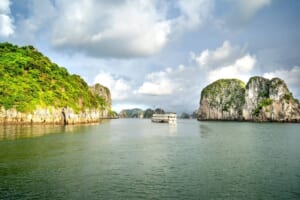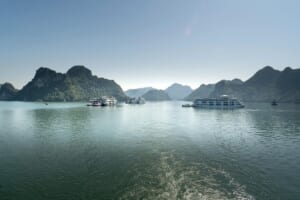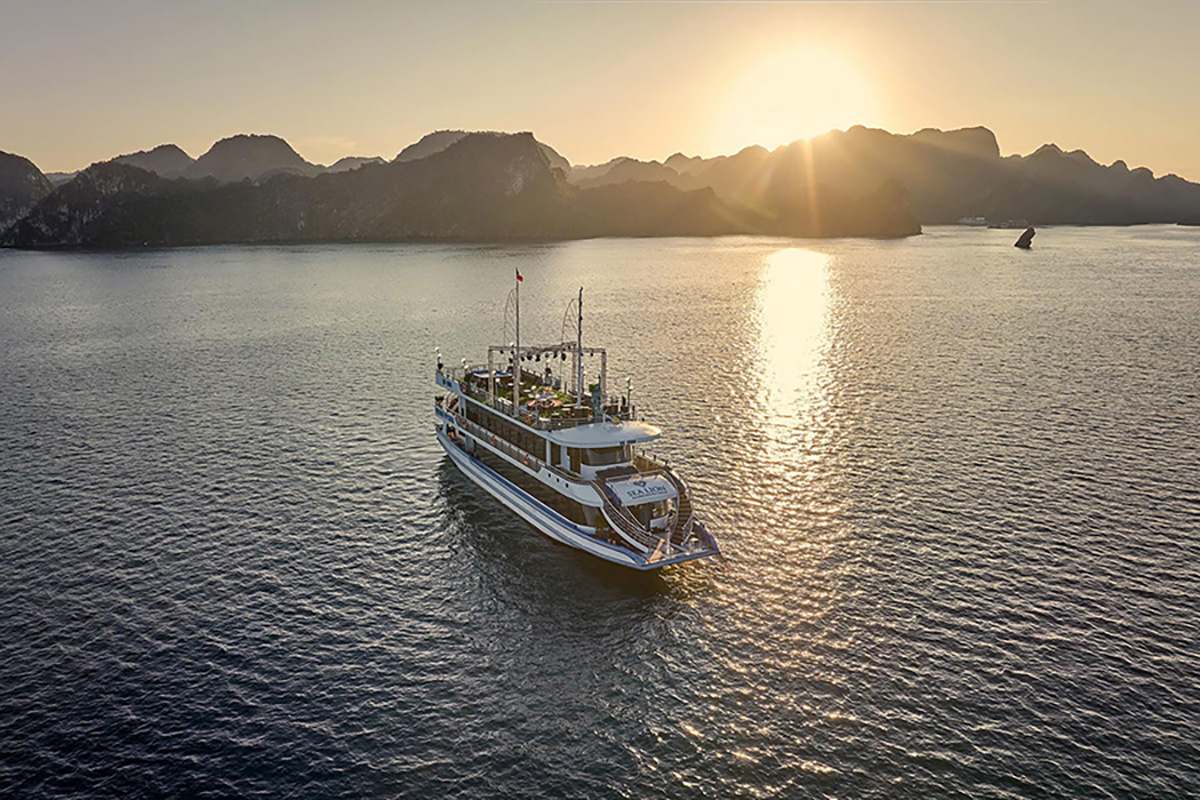
A Halong Bay photography guide that actually helps requires one thing most online lists skip: specific locations tied to specific times of day. The generic advice — “bring a wide-angle lens” — means nothing without knowing where to stand at 10:47 AM when morning haze lifts off 1,969 limestone karsts inside the UNESCO World Heritage site. This guide maps every photogenic moment on Sea Lion’s 6-hour route, from the sundeck departure at Tuan Chau Marina to the final karst silhouette on the return cruise.
Sea Lion’s route passes through three of Halong Bay’s most photographed zones — the Titov Island summit panorama, the interior of Sung Sot Cave, and the narrow waterway at Luon Cave — each offering distinct lighting conditions and compositional opportunities.
At a glance:
- Best overall camera position: Sea Lion’s upper sundeck, starboard side (right) during outbound cruise
- Golden hour window: Not available on day cruise — but the 2:00–3:00 PM light produces excellent warm tones on limestone
- Top 3 photo spots: Titov Island summit (panoramic), Sung Sot Cave Chamber 2 (interior), Tuan Chau Marina departure (wide bay)
- Drone policy: Banned in Halong Bay UNESCO zone — no exceptions
- Phone photography: Surprisingly effective. Night mode inside caves, panorama from summits
Halong Bay Photography Guide — Camera Gear Recommendations
The Halong Bay photography guide question “what camera should I bring?” has a practical answer: whatever you already own, plus one waterproof solution for kayaking. Sea Lion’s route doesn’t require specialized equipment — it requires understanding how to use your existing gear in specific bay conditions.
| Gear | Recommended | Why | Alternative |
|---|---|---|---|
| Camera body | Any with manual exposure control | Cave interiors need ISO/aperture control | Phone with Night Mode (iPhone 14+, Samsung S22+) |
| Wide-angle lens | 16–35mm equivalent | Karst panoramas from Titov summit, cave chambers | Phone ultra-wide (0.5x) |
| Telephoto | 70–200mm optional | Isolating individual karsts, fishing village details | Phone 3x–5x zoom |
| Waterproof case | Dry bag or phone pouch | Kayaking splashes are inevitable | Ziplock bag (budget solution — genuinely works) |
| Polarizing filter | CPL filter for interchangeable lens | Cuts water glare, deepens sky and karst contrast | Polarized sunglasses held in front of phone lens |
| Stabilization | Image stabilization ON, or small tripod | Cave interiors at 1/30s shutter need stabilization | Rest camera on cave railings, steady against walls |
⚓ Expert Note: The polarizing filter is the single most impactful accessory for Halong Bay photography. The bay’s emerald water reflects intense glare between 10 AM and 2 PM — a CPL filter eliminates it, revealing the actual water color and limestone detail that makes these images distinctive. Without one, you’re photographing white glare patches, not emerald water.
Shot-by-Shot Guide: Sea Lion’s Route
Stop 1: Tuan Chau Marina Departure (8:30–9:30 AM)
As Sea Lion pulls away from Tuan Chau Marina wharf, the first 30 minutes offer wide-angle compositions impossible from land. The morning haze typically lifts between 9:00–9:30 AM — before that, you get atmospheric layered-karst shots where formations fade into mist like watercolor gradations. After 9:30 AM, clarity increases and individual karst detail sharpens.
- Best position: Upper sundeck, starboard (right) side, facing south
- Settings: f/8, ISO 100–200, shutter 1/500+. Wide-angle for karst clusters, telephoto for individual peaks
- Composition tip: Include Sea Lion’s bow railing in the foreground for depth and scale — the karsts alone can look two-dimensional without a reference point
Stop 2: Titov Island Summit (2:00–2:45 PM)
The 428-step summit delivers what is widely considered the single best viewpoint in Halong Bay — a 360° panorama of hundreds of karsts rising from emerald water. Sea Lion’s afternoon timing is actually advantageous: the 2:00 PM sun is behind you (west), front-lighting the karsts with warm tones rather than the flat light of midday or the backlit silhouettes of morning.
- Best position: Summit platform, northwest corner. The railing serves as a camera rest for long exposures
- Settings: f/8–f/11 for maximum depth of field across karst layers. ISO 100. Wide-angle panorama mode works excellently
- Time allocation: Allow 20 minutes for the climb, 10 minutes at the summit for photography, 12 minutes for descent. Tight but achievable
- Pro technique: Shoot a multi-frame panorama (6–8 vertical frames) for a print-quality ultra-wide image. Phone panorama mode is the easy alternative
Stop 3: Sung Sot Cave Interior (2:45–3:30 PM)
Cave photography in Halong Bay requires adjusting to LED-lit interiors with extreme dynamic range. The 2022 lighting upgrade replaced garish colored spotlights with warmer, more natural tones — a significant improvement for photography.
- Settings: ISO 1600–3200, f/2.8–f/4, shutter 1/30 or slower with stabilization. Manual white balance set to tungsten or ~3200K
- Best formation: The 20-meter central stalagmite in Chamber 2, photographed from the elevated north walkway (40 meters into the loop)
- Hidden lake: Chamber 2’s exit opens to a limestone-enclosed lake — compose the shot framing the lake through the cave mouth for a natural-frame effect
- Phone tip: Night Mode produces surprisingly good results. Hold steady for 3–5 seconds — the computational photography handles the exposure stacking
Stop 4: Luon Cave Kayaking (Water-Level Shots)
Kayaking through Luon Cave offers a unique perspective: water-level photography through a limestone tunnel opening into a hidden lagoon surrounded by vertical karst walls. This is where waterproof protection becomes non-negotiable.
- The shot: Wide-angle from inside the cave tunnel, framing the bright lagoon through the dark arch — high contrast, dramatic
- Challenge: Paddling and photographing simultaneously. Solution: put the paddle down in the lagoon (calm water), shoot, then resume
- Settings: Let the camera meter for the bright lagoon; the cave walls become natural dark frames
Lighting Conditions by Time of Day
| Time | Conditions | Best For | Challenge |
|---|---|---|---|
| 8:30–9:00 AM | Morning haze, soft diffused light | Atmospheric layered-karst shots | Low contrast, hazy details |
| 9:00–10:30 AM | Haze lifting, increasing clarity | Clear karst profiles, water color | Glare beginning to build |
| 10:30 AM–1:00 PM | Overhead sun, maximum glare | Underwater visibility, overhead cave shots | Harsh shadows, flat front light |
| 1:00–2:00 PM | Sun moving west, warm tones beginning | Lunch deck shots, preparation | Still bright — sunscreen critical |
| 2:00–3:30 PM | Warm afternoon light, front-lit karsts | Titov summit, cave interiors, golden warmth | Limited time at each stop |
Drone Alternatives — Getting the Aerial Perspective
Drones are banned in Halong Bay’s UNESCO zone. Vietnamese authorities actively confiscate drones on sight — no permits exist for tourists, and enforcement is consistent. However, the aerial perspective is still achievable through two methods:
- Titov Island summit: At 100 meters elevation, the 360° view replicates what a drone would capture at the same altitude — and the composition is often better because you’re shooting from a fixed elevated point rather than a hovering position
- Extended selfie stick + ultra-wide: A 3-meter selfie stick with phone in ultra-wide mode produces elevated angles from the sundeck that simulate low-altitude drone perspectives. Not a perfect substitute, but effective for social media content
For the complete activity breakdown at each photo location, see our day cruise experience guide. Planning what to bring? Check the packing checklist for camera-specific gear. Book your Sea Lion departure at current prices from $49.
Frequently Asked Questions
What are the best photo spots on a Halong Bay day cruise?
The top three on Sea Lion’s route: Titov Island summit (360° karst panorama), Sung Sot Cave Chamber 2 (dramatic stalactite formations), and the Tuan Chau Marina departure view (wide bay with layered karsts). The sundeck offers continuous opportunities throughout the cruise.
Can I fly a drone in Halong Bay?
No — drones are banned in the entire Halong Bay UNESCO World Heritage zone. Authorities confiscate on sight with no tourist permits available. Use Titov Island’s 100-meter summit as a natural aerial viewpoint instead.
What camera settings work inside Halong Bay caves?
ISO 1600–3200, aperture f/2.8–f/4, shutter speed 1/30s with stabilization. Manual white balance at ~3200K matches the LED lighting. Phone Night Mode works surprisingly well — hold steady for 3–5 seconds.
{“@context”:”https://schema.org”,”@type”:”FAQPage”,”mainEntity”:[{“@type”:”Question”,”name”:”What are the best photo spots on a Halong Bay day cruise?”,”acceptedAnswer”:{“@type”:”Answer”,”text”:”Top 3 on Sea Lion: Titov Island summit (360° panorama), Sung Sot Cave Chamber 2 (stalactites), and Tuan Chau Marina departure (wide bay). Sundeck offers continuous opportunities.”}},{“@type”:”Question”,”name”:”Can I fly a drone in Halong Bay?”,”acceptedAnswer”:{“@type”:”Answer”,”text”:”No — drones banned in entire UNESCO zone. Confiscated on sight. Use Titov Island summit (100m elevation) as natural aerial viewpoint.”}},{“@type”:”Question”,”name”:”What camera settings for Halong Bay caves?”,”acceptedAnswer”:{“@type”:”Answer”,”text”:”ISO 1600-3200, f/2.8-f/4, 1/30s shutter with stabilization. White balance ~3200K. Phone Night Mode works well.”}}]}
{“@context”:”https://schema.org”,”@type”:”Article”,”aggregateRating”:{“@type”:”AggregateRating”,”ratingValue”:”4.9″,”reviewCount”:”356″,”bestRating”:”5″,”worstRating”:”1″}}